AAV characterisation is often discussed in terms of empty and full capsids and their respective ratios, but the real analytical challenge can be broader than that.
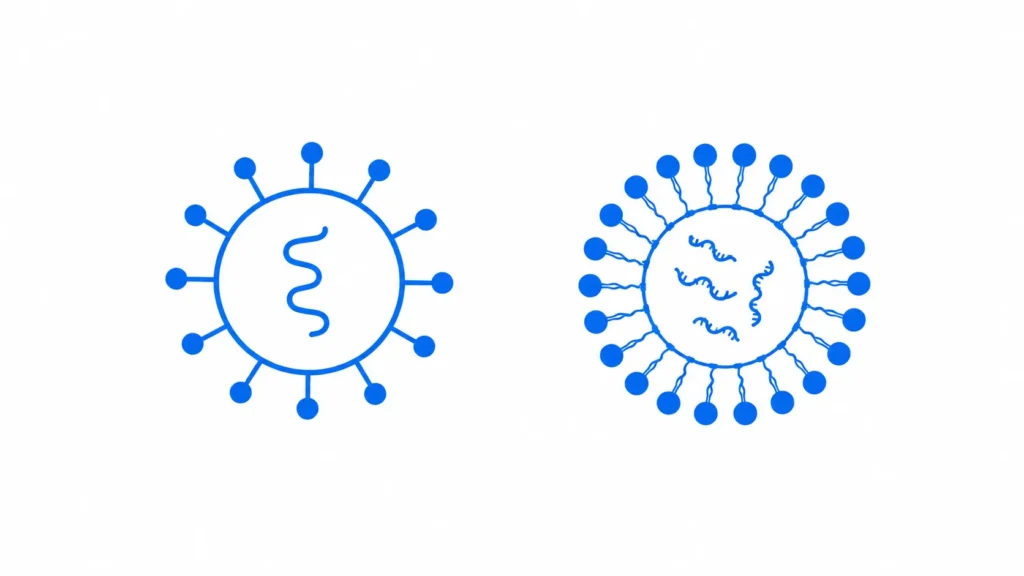
An AAV preparation may contain multiple related populations. There may be empty capsids, partially packaged capsids, full capsids, overfilled capsids, aggregates and other species. Depending on the stage of development, the key question may be different.
- A researcher may want to understand the effect of temperature change.
- A formulation scientist may want to know whether a new buffer has shifted the population stability.
- An analytical scientist might want to compare replicates or understand heterogeneity in more detail.
In each of these cases, the sample is not one thing. It is a population.
Why averages are useful but incomplete
An average may describe a sample broadly, but it may not reveal the underlying distribution or how it interacts with its surroundings. For AAVs and other viral vectors, understanding these varying distributions can be important for development, comparability and scientific interpretation.
Where CDMS is relevant
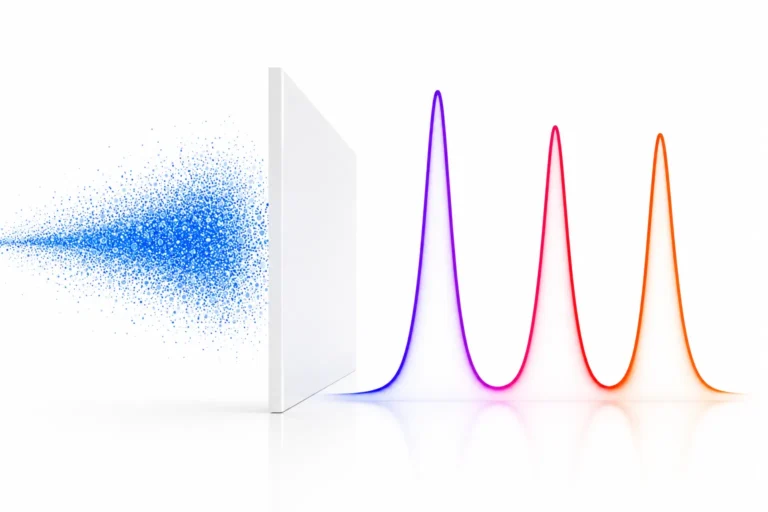
Charge Detection Mass Spectrometry is relevant because it measures individual ions and determines intact mass by measuring both m/z and charge. This allows population-level analysis of large particles that can be difficult to interpret using conventional mass spectrometry approaches alone.
CDMS should not be viewed in isolation. It is one part of a broader analytical workflow. Techniques such as AUC, SEC-MALS, native MS, mass photometry, cryo-EM and other methods may all provide valuable information. The question is which information is needed and which method is best suited to provide it.
For AAVs, CDMS may be particularly useful when intact mass and population distributions are central to the question.
The questions that will shape CDMS in gene therapy
At TrueMass, we are interested in conversations with scientists working on AAVs and viral vectors because the application questions are practical and important.
- What populations are present?
- How do they change?
- What can be measured directly?
- Where can we use CDMS to add more insight to the questions that the community is asking?
Those are the questions that will shape how CDMS is used in gene therapy workflows.
For research use only. This information is subject to change without notice.