
CDMS explained
What is Charge Detection Mass Spectrometry?
Charge Detection Mass Spectrometry, or CDMS, is a mass spectrometry approach that determines the mass of individual ions by measuring two values for each detected ion: mass-to-charge ratio (m/z) and electrical charge.
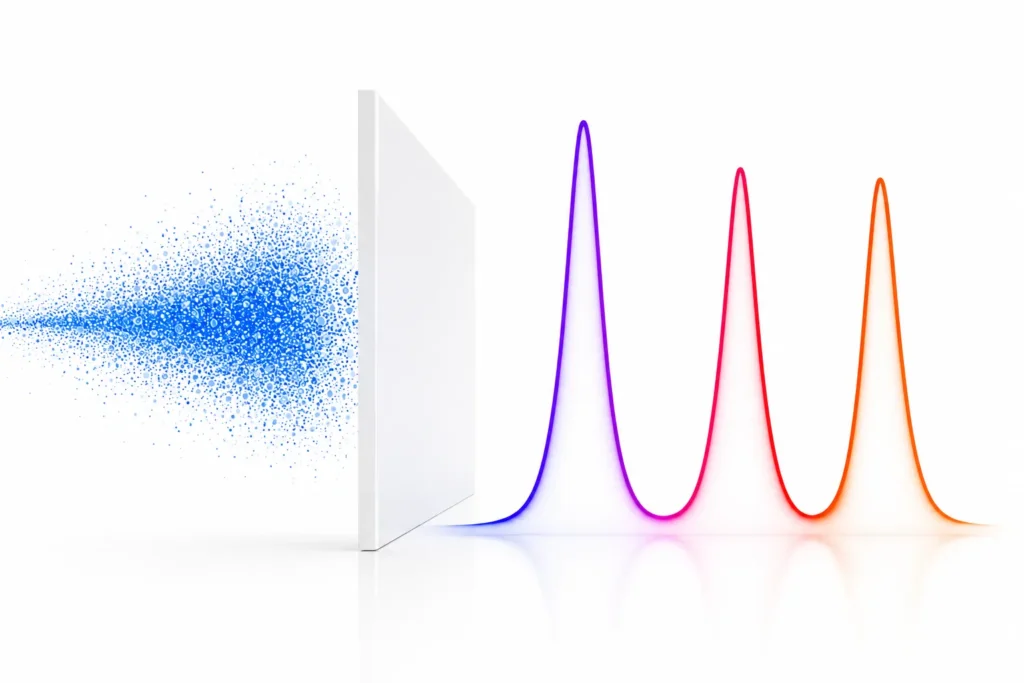
When both values are known, the mass of the ion can be calculated directly. Repeating that measurement across many ions produces a mass distribution, giving a particle-by-particle view of large and heterogeneous samples.
Why CDMS?
Mass spectrometry is highly effective for determining molecular mass, but very large and heterogeneous particles can be difficult to interpret using conventional approaches alone.
As particles become larger, charge-state distributions can broaden and overlap. When charge states are no longer clearly resolved, converting an m/z spectrum into an intact mass becomes more challenging.
CDMS addresses this by measuring charge directly for each ion rather than relying only on charge-state assignment from the spectrum.
Why does measuring charge matter?
A mass spectrometer measures mass-to-charge ratio, not mass by itself. Charge is therefore essential to the mass calculation.
For relatively homogeneous samples, charge-state assignment may be straightforward. For very large or heterogeneous systems, it can become difficult. Direct measurement of charge reduces that dependence on resolving charge states first and allows the mass of each detected ion to be calculated individually.
What does a CDMS experiment produce?
A CDMS experiment produces many individual-ion measurements. Together, those measurements create a mass distribution that can help show whether a sample contains one dominant population, several related populations, a broad distribution or unexpected high-mass species.
Depending on the sample and the analytical question, CDMS can support investigations such as:
- Whether multiple particle populations are present
- How broad or heterogeneous a mass distribution is
- Whether related high-mass populations can be distinguished
- Whether a process, formulation or storage condition has changed the distribution
- Whether unexpected higher- or lower-mass species are present
- How one sample compares with another

What kinds of samples are being studied?
CDMS is being explored across a growing range of high-mass and heterogeneous systems, including AAV and other viral vectors, lipid nanoparticles, extracellular vesicles, virus-like particles, large protein complexes, macromolecular assemblies, synthetic nanoparticles and high-mass polymers.
AAV and other viral vectorsLipid nanoparticlesExtracellular vesiclesVirus-like particlesLarge protein complexesMacromolecular assembliesSynthetic nanoparticlesHigh-mass polymers
The application name alone does not determine whether CDMS is useful. The key question is whether individual-ion intact mass or population-level information would add something meaningful to the analytical workflow.
Where does CDMS fit with other analytical techniques?
CDMS is complementary to other analytical methods. Native mass spectrometry, analytical ultracentrifugation, SEC-MALS, mass photometry, electron microscopy, cryo-EM, ion mobility and related approaches provide different types of information.
CDMS contributes a specific measurement: charge and m/z for individual ions, converted into intact mass and a high-mass population distribution. In many studies, the strongest interpretation will come from combining CDMS with orthogonal measurements.
Is every sample suitable for CDMS?
No. Sample quality, concentration, buffer composition, ionisation behaviour, expected mass range and the degree of heterogeneity all affect whether a useful CDMS measurement can be made.
The best starting point is the scientific question. What are you trying to distinguish, compare or understand, and what do your current methods already tell you? That is usually enough to decide whether a CDMS discussion is worthwhile.
Frequently asked questions
Not sure if CDMS fits?
Talk to TrueMass about CDMS
If you are working with a large or heterogeneous system and are not sure whether CDMS is relevant, tell us what you are trying to understand. We can start with the analytical question and discuss whether CDMS adds useful information.